
The Ritz Ballroom
Lesser Charges

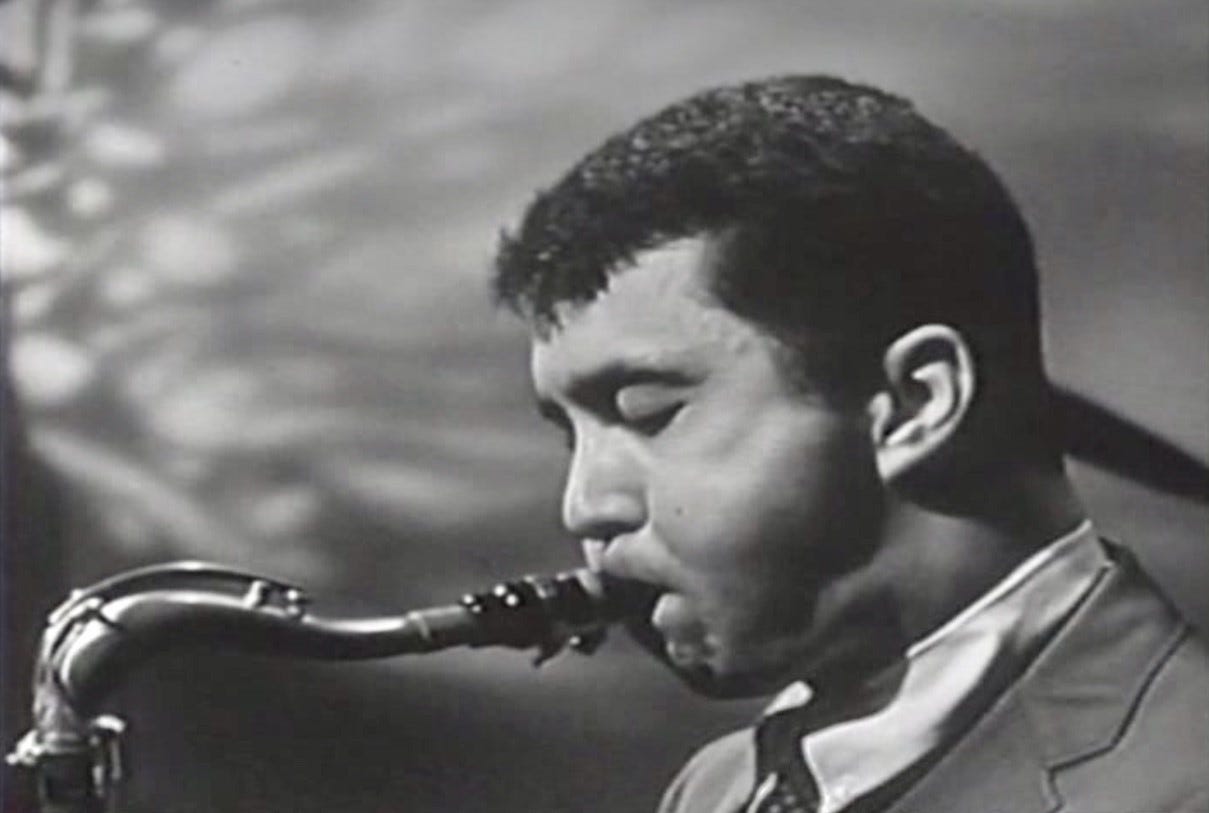
Richie Kamuca
My active musical life started at the Ritz Ballroom in Bridgeport, Connecticut. I lived in Milford, about eight miles from Bridgeport, also on Long Island Sound. The Ritz was on the touring circuit and so I’d see the big bands when they came through, good bands like Les Brown’s and Buddy Morrow’s, and great bands like Duke Ellington’s, Count Basie’s, Woody Herman’s and Louis Armstrong and his All-Stars, a sextet. Louis’ clarinetist was the great Barney Bigard, whom I chatted up during an intermission. I was in heaven. I was only 16, a sophomore, and didn’t get my driver’s license until I was 18, so, usually by myself, I went to the Ritz by bus and made sure to catch that last bus back to Milford.
The Ritz wasn’t fancy but it looked and felt like a ballroom. And it had a mezzanine where people socialized. Very cool. Except for me and a few other oddballs, everyone was coupled off, and dancing was big. Going out dancing was something couples did regularly. There was a Friday and/or Saturday night dance virtually every week in every small town in America, either at a school auditorium or the rec center or in rented halls at the Elks Club or the VFW.
The Ritz floor was always crowded. I’d work my way right up to the apron of the stage and stay there until the set was done, and even after, sometimes trying to engage a musician into the slightest of dialogues, or sometimes just to get a load of the ambient stuff on a bandstand—an open page of sheet music, a gleaming gold saxophone resting in its stand.
I remember watching the Herman band, probably early 1954, with its famous Four Brothers sax section—three tenors and a baritone. What I mostly remember is the excitement I felt when Richie Kamuca stood up from that section to take his solo. I forgot the tune but it was a slow ballad. Despite the full band blowing hard behind him, his tenor still soared over the whole ensemble, creating high drama and embedding itself in my memory. Aside from what he played, I was excited by the way Kamuca stood up, and that he stood up at all. No one usually goes down to stage level to take his solo (unless it’s going to be an extended solo, something like Paul Gonzalves at Newport blowing fifty choruses of the blues) but you do stand up—in your section. It’s like a team thing. The stars (soloists) stand up and stand out but let’s not get carried away: There’s the arrangement, the rhythm section, your bandmates. Ultimate success depends on a team effort. Without it you’re not going to sound good. That’s why I dig team sports and big bands.
That Herman band was the most exciting band I’ve ever seen. Basie’s band swung more, with more emphasis on the rhythm section and the blues in general, while Herman’s band was loud and brassy, in the best sense. Duke’s band had the beautiful arrangements. Not that they couldn’t swing, but Duke was a composer who, it is said, used his band as an instrument for his songs. That his songs are among the greatest ever written was a big plus for the band. Duke’s band relied on its soloists more than most bands do. Herman’s band was never known for its soloists, though it had good ones, but for its ensemble sound.
I was already into the small bebop combos by then but the big bands really grabbed me, and still do.
Enjoyed it Eugene!
Loved your post today! Thanks Cuz!